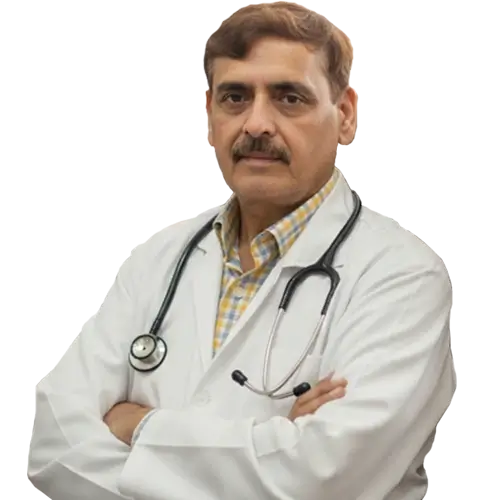
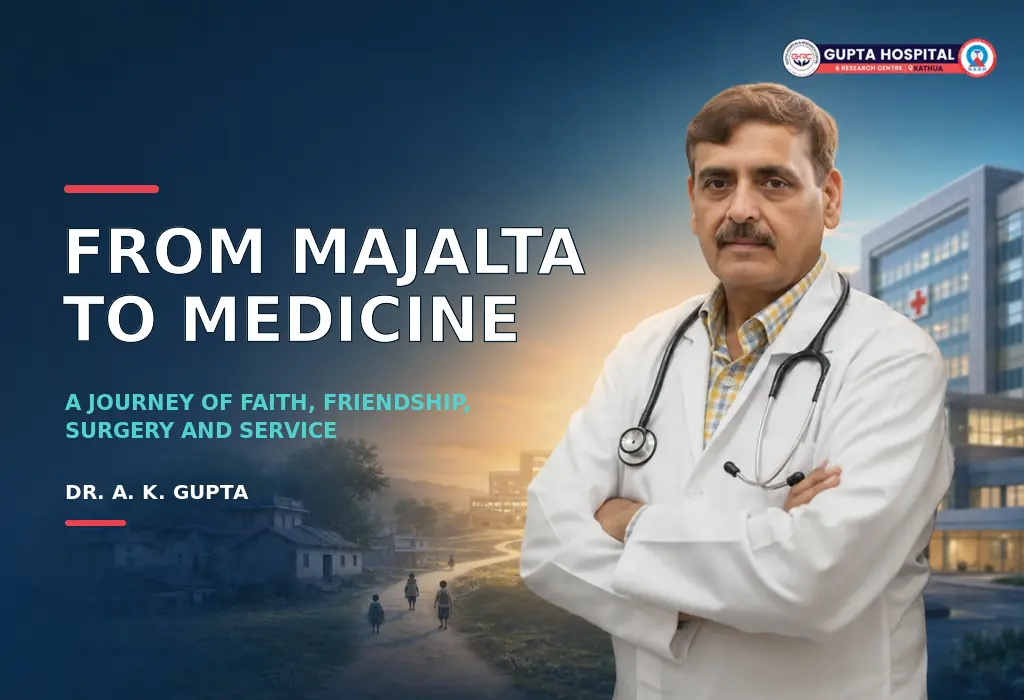
Every life has a story. Mine began in a small village, in a modest trading family, with limited resources but with a strong belief in education.
I was born on 24 October 1965 to Shri Chunnilal Gupta and Shrimati Tara Devi in Majalta, Udhampur district of Jammu.
In the early 1960s, my father, along with about ten to twelve other families, had migrated from Tajur to Majalta to establish their businesses. We belonged essentially to a trading community. The prevailing land laws in Jammu and Kashmir did not provide our community the right to own agricultural land. Consequently, there was no agricultural land available to our family, and our livelihood depended entirely on the shops and trading businesses that our families established.
I grew up with five sisters and two brothers. Some of the families who had migrated with us had children who became doctors and engineers. Relatives settled in Udhampur and other towns also became a source of inspiration. They showed us that, irrespective of one’s circumstances, education could open a completely different world.
I studied at Government High School, Majalta, and passed my matriculation in 1981. I subsequently completed my higher secondary education at Government Higher Secondary School, Udhampur.
Then came the turning point of my life.
The Door to Aurangabad
In 1983, I secured admission to Government Medical College, Aurangabad.
Even reaching the college was not straightforward.
When I travelled to Aurangabad for admission, accompanied by my brother, I was initially told that I was not eligible because of a question regarding my higher secondary subjects. I had studied Physics, Chemistry, Biology and English, but had not studied Mathematics.
My case was referred to Dr. Mohan Javele at Marathwada University. The matter took about one month to be clarified. Dr. Javele examined the requirements and clarified that Mathematics was not required for admission to MBBS in my circumstances. His intervention resolved the issue, and I was finally admitted to Government Medical College, Aurangabad.
There was a beautiful coincidence in this episode. Years later, I came to know that Sunil Jawle, who became one of my earliest friends and roommates at medical college, was Dr. Mohan Javele’s son.
I joined the college in December 1983, rather late in the academic year. I had missed the beginning of the first MBBS year and had to work hard to catch up. When I appeared for my first MBBS examination in November 1984, I was extremely anxious about whether I would pass.
By the grace of God and with the support of my friends, I did.
That experience taught me one of the earliest lessons of my life:
A difficult beginning does not necessarily determine the outcome.
The People Who Became Family
Perhaps the greatest gift of Government Medical College, Aurangabad was not only the education—it was the people.
My earliest friends were Nilkanth Sagar and Sunil Jawle, who became my roommates and companions.
As the years passed, our circle of friendship expanded. Among those who became particularly close were Raghu Nalgirkar, Tammewar, C. P. Bhale, Vijay Pathil, Anil Salunkhe, Anil Shinde, Sudhir Saraf, Hitesh Raithatta and Vijay Sikchi.
There were many more friendships that became an important part of my college years, including Rajendra Tungenwar, Amul Sulakhe, Arun Khiste, Kranti Raymane, Vikram Halikar, Manoj Kasliwal, Sunil Kulkarni, Shri Krishna Kulkarni, Sanjay Suryavanshi, Raju Sable, Ingale, Manoj Ghogre, Shasturkar, Patange, Bhavsar, Bhushan Malewar, Kala and Pramod Nichat.
There were also Prasanna Mishrikotkar, Menon, Sudhakar Bokare, Neeraj Dubey, Sanjay Rakh, Ganesh Rathod, Sanjay Rathod, Anil Godha and Datta Pawar, along with countless other colleagues and friends.
Among Our Women Classmates
Among the women classmates of our 1983 batch were Sushma Deshmukh, Jayshree Bhale, Anjali Nade, Smita Kolhe, Sunita Korane, Rashmi Borikar, Sapna Khandharkar, Anuradha Kudrimoti, Jyotsna, Varsha Kulkarni, Varsha Deshpande, Sandhya Choudhary, Ms. Smita Ghogle, Manju, Seema, Sheela, Rahila, Jyoti, Anjali Pranjape, Kalpana Sukalkar and Mridula, along with many other classmates and friends who were an integral part of our memorable years at Government Medical College, Aurangabad.
Their presence, friendship and companionship were an important part of our batch life. Together, we shared the same classrooms, examinations, celebrations, anxieties and countless memories that have remained with us long after we left medical college.
I hesitate to name everyone because the list would be endless, and I would inevitably leave out someone who deserves to be remembered.
What matters is that we came from different places and different backgrounds, but medical college quickly transformed us into a family.
We studied together, lived together, laughed together, worried together and grew up together.
Those friendships have survived more than four decades.
The Battle for MS Admission
After completing MBBS, I wanted to pursue MS in General Surgery.
Although I was in the merit list, an objection was raised that, being from outside Maharashtra, I could not be considered for the institutional seat.
Once again, my friends stood by me.
I travelled to Mumbai and met Dr. Sathe, Director of Medical Education, who had himself been a professor at Aurangabad. He assured me that I should be eligible and advised me to approach Mantralaya.
The next morning, he himself came to Mantralaya and introduced me to Ms. Madhuri Konkane, Under Secretary.
She helped resolve the matter, and an order was issued directing that I should be considered as an institutional candidate.
Dr. Agarwal was the Dean, and ultimately I was admitted to MS General Surgery.
Looking back, I realise how fortunate I was that whenever a door appeared to be closing, someone came forward to help open it.
The Golden Years of Surgery
My MS years were among the most intense and rewarding years of my professional life.
We worked under several dedicated teachers and surgeons, including Dr. Malik, Dr. Kanchan, Dr. Vyavhare, Dr. Dawar, Dr. Gomaste, Dr. Pohekar, Dr. Varudkar and Dr. Kalamkar, among others.
My colleagues included Dr. Sanjay Deshmukh, Dr. Atul Deshmukh, Dr. Sushil Deshpande, Dr. Achwal, Dr. Deodhar, Dr. Takalkar, Dr. Bokare, Dr. Sanjay Rakh, Dr. Nusrat Farooqi, Dr. Pagare, Dr. Madhu Rathod, Dr. Ankushkar, Dr. Bilolikar, Dr. Bhasale, Dr. Musande, Dr. Gopal Rathi, Dr. Jatin Kulkarni, Dr. Sachin Jhawar, Dr. Shivaji Wadekar, Dr. Totla, Dr. Nichat, Dr. Darshane and Dr. Bapat, along with many other colleagues who shared those demanding years with us.
We worked day and night.
We performed emergency laparotomies for perforations and intestinal obstructions, resections, carcinoma breast surgery, prostate surgery and a wide variety of major and emergency procedures.
The amount and variety of surgery we performed as young trainees were extraordinary.
We were given responsibility.
We made mistakes.
We learnt from those mistakes.
And gradually, we became confident surgeons.
Those years taught me that surgery is learnt not only from books, but from the patient on the operating table and from the teacher standing beside you.
A Friendship That Became a Professional Partnership
One friendship deserves a special mention—Dr. Ragu Nalgirkar, who was pursuing MD in Anaesthesia.
We had become close friends during our MBBS years, and our friendship became particularly valuable during the MS period.
He would provide the anaesthesia and I would perform the surgery. Whenever there was a difficult or interesting case that I wanted to operate upon, I could often call upon him.
We worked together through numerous emergencies, sometimes at all hours of the day and night.
That close coordination between the surgeon and anaesthetist was an enormous advantage during those formative years.
I remain deeply grateful to Dr. Ragu Nalgirkar for that friendship, professional partnership and support during some of the most important years of my surgical training.
Mumbai and the New World of Laparoscopic Surgery
After MS, I moved to Mumbai and worked at institutions including Breach Candy, Nanavati and R. N. Cooper Hospital.
At Breach Candy, I had the privilege of training under Dr. T. E. Udwadia, at a time when laparoscopic surgery was still a relatively new technique.
It was an exciting period in surgery.
Patients from Delhi, Punjab and Jammu frequently travelled to Mumbai for gallbladder surgery. We would perform several laparoscopic cholecystectomies in a day, often working from morning until evening.
At that time, a laparoscopic operation could take two to three hours or more.
Learning this new technique required patience, discipline and repeated exposure.
Those years profoundly influenced my surgical career.
One Case Remains Particularly Memorable
Shankarsinh Vaghela, then a Member of Parliament and later Chief Minister of Gujarat, underwent laparoscopic gallbladder surgery under Dr. Udwadia. Later that day, during my round, I noticed approximately 300 cc of bile in the drain.
I immediately informed Dr. Udwadia.
We explored the patient and found that the clip on the cystic duct had slipped. We secured the duct, placed a drain and continued his care.
He recovered well and was discharged after about a week.
For a young surgeon, it was a lasting lesson:
Recognising a complication early can be as important as performing the operation itself.
The Oman Opportunity
During this period, I was offered a position as a Junior Specialist in Surgery in the Sultanate of Oman.
The opportunity came through an Omani official whose relative had undergone laparoscopic surgery at Breach Candy.
At the interview, a European surgeon asked me about a patient who suddenly developed breathlessness after gallbladder surgery.
I answered:
“Pulmonary embolism.”
I was selected.
There was another remarkable coincidence.
I did not have a passport. Fortunately, another patient, Mr. R. K. Sharma, a senior passport officer whose mother had been treated at Breach Candy, helped me obtain one in approximately 48 hours.
Everything seemed ready.
The job was secured.
The documents were ready.
The passport was ready.
Muscat seemed to be my next destination.
But then I went home.
The Decision That Changed Everything
In those days there were no mobile phones, WhatsApp or instant communication. I had written to my parents informing them that I had been selected for Oman.
When I reached home, their reaction was different from what I had expected.
They asked me:
“If you go to Oman, what will happen to your family and to the people here?”
They worried that if I went abroad, perhaps I would eventually move to America, Australia or somewhere else, and that I would become disconnected from my family and community.
Their words made me think deeply.
The Oman opportunity was attractive.
But eventually I decided not to go.
I chose to return home.
That decision changed the course of my life.
Shahidi Chowk — The Real Beginning
On 25 September 1995, I started a five-bedded nursing home at Shahidi Chowk, Kathua.
Those early years were challenging but immensely formative.
There were limited facilities and relatively few specialists. During harsh winters, patients often had to travel to Jammu or Pathankot for emergency treatment.
Very early in my practice, a young patient was brought to us in a pulseless condition following a severe anaphylactic reaction after an intramuscular injection.
We immediately started CPR, administered adrenaline and continued resuscitation.
Against the odds, the patient was revived.
The incident changed the visibility of our practice almost overnight.
Another memorable event occurred during gallbladder surgery under spinal anaesthesia when the patient developed cardiac arrest.
Again, resuscitation succeeded.
The patient survived.
These experiences taught me humility. They also strengthened my belief that when a crisis comes, a doctor must do everything humanly possible—and then leave the outcome to God.
Learning Because Patients Needed Us
Kathua in those days had limited specialist services.
At one point, the district hospital faced a shortage of anaesthesia services, and women requiring emergency Caesarean sections were being referred to Jammu or Pathankot.
Some of these patients began coming to us.
I was a surgeon, not an obstetrician, and I had never routinely performed Caesarean sections.
But the patients needed help.
So I learnt.
Emergency Caesarean sections were performed, sometimes in the middle of the night. With experience, our work expanded to abdominal and vaginal hysterectomies and other gynaecological procedures.
Looking back, I realise that many services in our hospital did not begin because of a business plan.
They began because a patient arrived with a problem and somebody had to find a solution.
From Five Beds to an Institution
The five-bed nursing home gradually grew.
The institution later shifted to Kalibari, Kathua, and expanded into a larger multispecialty hospital.
What began with five beds eventually became Gupta Hospital & Research Centre, providing a broad range of medical, surgical, cardiac, critical-care, diagnostic and other healthcare services.
But whenever I look at the hospital today, I still remember those five beds at Shahidi Chowk.
That is where the real journey began.
What the Journey Has Taught Me
Looking back, I do not see a straight road.
I see a series of turning points.
Some doors opened because of hard work.
Some opened because of teachers.
Some because of friends.
Some because of strangers who became well-wishers.
And one important door—the door to Oman—closed because of a decision made at home.
Only later did I understand that the closed door had redirected me towards something that perhaps was meant for me.
Medicine taught me that knowledge and technical skill are essential, but they are not enough.
A doctor must also accept responsibility.
One must remain calm when others are frightened.
One must have the courage to learn when the patient in front of you needs something new.
And one must never forget that behind every diagnosis is a human being and a family.
Looking Back at Our Batch
As we meet again in Nagpur, more than four decades after entering medical college, I think about the young students we once were.
We came from different places. We had different dreams.
We shared classrooms, hostels, examinations, operating theatres, meals, laughter and anxieties.
We made mistakes. We learnt. We grew up.
Then life took us in different directions.
But the bond remained.
When we meet again, the years seem to disappear. For a while, we are students again.
We remember the corridors of our college, our teachers, our friends and the dreams we carried when we were young.
Perhaps that is the greatest gift of Government Medical College, Aurangabad.
We did not merely study medicine together. We grew up together.
My journey began in Majalta, Udhampur district of Jammu, took me to Aurangabad and Mumbai, brought me back to Kathua, and eventually led to the building of a healthcare institution.
I cannot say that I planned every step.
I simply kept taking the next one.
And at every important stage, someone helped me—my parents, my teachers, my friends, my colleagues, my patients and, above all, the grace of God.
Today, I look back not merely with pride, but with gratitude.
Gratitude for the opportunities. Gratitude for the friendships.
Gratitude for the teachers. Gratitude for the patients who trusted me.
And gratitude for a journey that I could never have imagined when I left my small village as a young student.
From Majalta to Medicine, from surgery to service, and from five beds to an institution—the journey continues.
And perhaps that is what life in medicine is ultimately about:
To learn. To serve. To remain grateful. And to leave something behind that continues to help others.